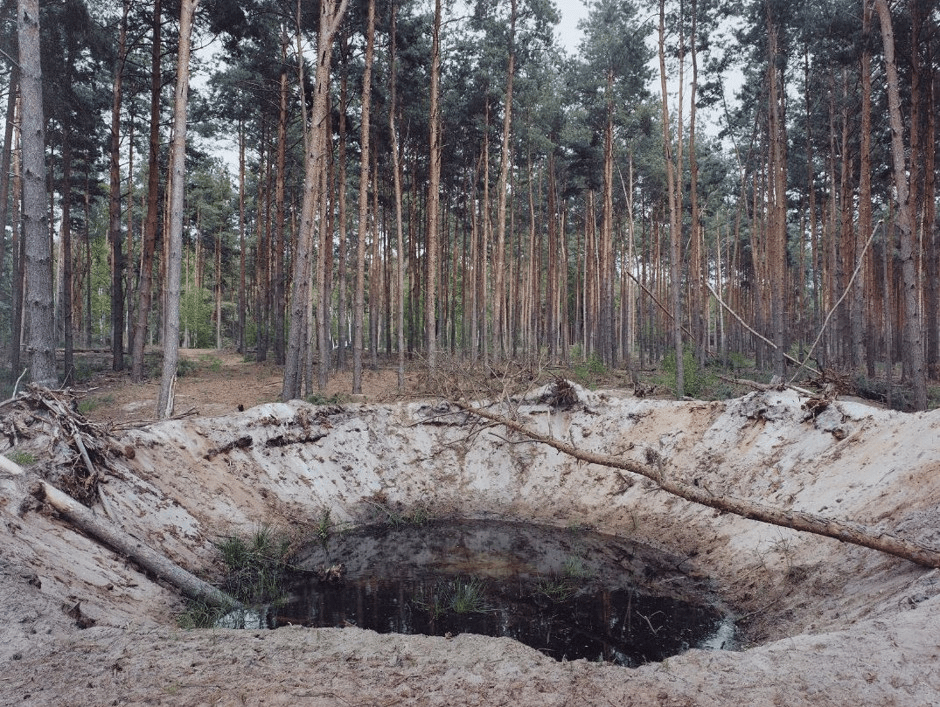
Shaking himself out of his reverie, Aurelio turned and walked out of the town hall, Sakari by his side; no telepathy was needed to agree that a walk was the next move. As they walked, Aurelio couldn’t help but mourn the damage the town had suffered; so many familiar places gone forever. Large chunks of the town had previously been houses and offices; transmutation bombs had warped them into strange materials and unnatural shapes.
Read more: The Eleventh Interval Excerpt – Aurelio and Sakari at the craterWith a pang, Aurelio saw a blank wall of stone where a corner shop had once stood. Diego had lived in a flat overhead, as his parents had owned the shop. The strange experience two weeks ago came back to him, and all of a sudden, the overwhelming weight of loss slammed into him. He averted his eyes, looking across the street, where scaffolding had grown up like vines, building new houses in vacant lots where the old ones had been dispersed into air. Pain clutched at Aurelio as he remembered how he and Diego and Sakari had run or cycled past those houses, growing up. Wiping his eyes, Aurelio kept walking. Sakari, looking concerned, kept pace. “Aurelio? Is everything OK?” she asked.
Aurelio shook his head, not trusting himself to speak. “I miss Diego – haven’t heard from him since the war,” he signed, hating himself for the half-truth. I should tell her, he thought, But she’s happier now than I’ve seen her be in ages, and I don’t want to ruin that.
“I miss him too,” Sakari signed. “Do you remember that time Diego rescued a baby pangolin?” she asked.
Aurelio smiled. “And brought it to school, insisting that the nurse heal it,” he replied.
“That’s when you reminded him that he could heal it,” Sakari signed, “And his face lit up, while we were cracking up that he’d forgotten about his powers.”
He laughed. “Well, we were ten at the time, you can’t blame him,” Aurelio signed. “You know, I’ve always thought it was that basic compassion that attracted you to him in the first place,” he continued.
Sakari swatted him. “I did not fancy him! I’m never gonna live this down, am I?” she signed emphatically.
“Sakari, I caught you staring at him. Multiple times,” Aurelio signed back, laughing.
She rolled her eyes dramatically. “I’m an artist, Aurelio, I appreciate the gods’ handiwork,” she retorted.
“Mhm, yup,” Aurelio signed sarcastically. Sakari rolled her eyes again and muttered; Aurelio, however, was distracted by a familiar sight – one he’d dreamt about for many months. With a shock, he realised that he’d subconsciously guided them to the ruins of his old house. He walked towards the crater in a daze. The old grief surged up within him, like a wave crashing upon a familiar shore. He knelt at the rim of the crater, ignoring Sakari’s gasp of alarm, and drew in ambient energy, causing the world to go silent as his hearing aids glitched. Looking up, Aurelio saw two visions flickering in and out of existence – the crater and the house as it had been, low, squat, and comforting. With a barely repressed sob, he saw shadows flickering in one of the bedrooms. And…something else. A figure standing in the crater, examining something. And then the visions stopped with a sharp electric crack as someone pulled on his shoulder. Sakari was kneeling beside him, looking concerned. “Aurelio, this isn’t healthy. I know how much xxx hurts – I miss them too. But you can’t just bury yourself in the past,” she said, enclosing him in a hug.
Aurelio nodded and stood up. “I…think I saw something. In the crater,” he said. Acting impulsively, he wriggled down the crater to the bottom. Sakari, yelling in alarm, followed him; he ignored her. To Aurelio’s disappointment, whoever had stood in the crater had done so quite some time ago; weather had long since eroded any footprints. Growing anxious, he spotted some cables poking out of the side of the crater, sheared off by the transmutation bomb.
Sakari noticed at the same time and gasped, “Oh, no. You’re not going xxx,”
Aurelio barely heard the rest of her protests; in desperation, he grabbed the cables and drew in electricity. It surged through his body, ripping along his nervous system like napalm; he screamed and blacked out.
Aurelio woke abruptly a second later to Sakari slapping him back to consciousness – harder than necessary, he thought. “What was that for? You idiot, you could have died!” she shouted, tears in her eyes.
Aurelio winced, guilt spiking in his stomach. Every muscle in his body ached like he’d run a marathon. “I’m sorry, I got desperate-” Sakari snorted disparagingly in reply, and he continued, “But I saw Tica. He’s alive, and he was here, in the crater, just two weeks ago!” he exclaimed. Two weeks ago…the day I saw him.
Sakari looked doubtful. “But…if he’s OK, why not come back to us?” she asked.
Aurelio shrugged again. “I don’t know. But we’ll have to find out, won’t we? We need to find him,” he said.
Sakari frowned. “But the meeting will be over in a few hours, xxx parents will be worried,” she said.
“Well, yeah. We can sit around and do nothing, maybe explore more of what used to be our home. Or we can do something. We can find Tica, we can help him,” he said, waggling his eyebrows.
She perked up but still looked hesitant. “Right, so what did you see?” she asked doubtfully.
Aurelio frowned. “I’m…it’s strange. I saw him, very vividly – it was definitely Tica. But he seemed to be looking for something. He didn’t seem lost, or despondent, he looked determined,” he said, furrowing his brow in confusion.
Sakari looked as confused as Aurelio felt. “Did you see what he was looking for?” she asked.
Aurelio shook his head. “You know how it is; the visions don’t last long – especially when it’s someone I care about,” he said regretfully.
Sakari grabbed his hand in her own. “Try again, then. Maybe xxx ground you,” she said, smiling.
He shrugged. “Worth a shot,” he replied, closing his eyes. He felt the sunlight streaming into his body, a glowing warmth which electrified every nerve and every cell. A faint buzzing and crackling, more tangible than audible, hissed all around him; the abandoned cables hummed with vivid intensity. And…a shadow swam before him. Ticasuk, crouching in a muddy crater, scant feet from where Aurelio stood. He’d been here, barely two weeks ago. His expression confirmed Aurelio’s first impression; as he looked closer, however, he saw something else. As Aurelio realised this, however, the vision wavered. He screamed internally, pushing for more, pushing for Ticasuk’s location. The vision collapsed entirely, leaving Aurelio drained; he opened his eyes and swayed, Sakari supporting his weight. “Well? What did you see?” she asked apprehensively.
“More or less just confirmed what we already knew: he was here, a couple of weeks ago, and he was looking for something. But he was…scared, Sakari. Scared and apprehensive,” Aurelio said.
Sakari looked stunned. She said, “Wait. Two weeks ago? That’s when he left. So-”
“-he left, and immediately came back here, looking for something,” Aurelio finished. A thought occurred to him. “I saw him, two weeks ago, here! He didn’t say why he was back home, but…”
“It must’ve been to do with whatever he was looking for!” Sakari added. She raised her eyebrows. “Hang on, what were you doing here two weeks ago? And how come you didn’t mention it?”
Aurelio winced, thinking of Diego. “I…needed to come back. Either way, I didn’t know he’d run off,” he said, and Sakari shrugged.
Fun fact, I am writing a novel! It’s called The Eleventh Interval, and it’s a science-fiction/urban fantasy story. Set in the aftermath of a brutal war, the story sees the protagonists, Aurelio and Sakari, struggling to come to terms with the past, when they discover something even more terrifying than the previous war. This sequence is one of the first sequences I wrote, though it has undergone substantial changes since I first wrote it! It features Aurelio and Sakari coming back to the remains of his home, which was destroyed on the final day of the war, and it shows how the war has affected the two of them. The scene itself is an amalgamation of two scenes that were previously separate: one featuring Aurelio and Sakari bonding, and the other featuring Aurelio, desperate to find his siblings, exposing himself to high-voltage electricity. (This makes sense in context, I promise!)
As can be seen, there is a magic system in play here (I love magic systems). Keeping it brief: Aurelio has the power to see the future and the power to magically locate people or objects. When he uses these powers at the crater, he sees glimpses of the past, first of the house before its destruction, and then of Ticasuk (Sakari’s brother) in the crater some time later. These powers are fuelled by different wavelengths of the electromagnetic spectrum, e.g. visible light, ultraviolet light, and so on. Aurelio’s powers are fuelled by x-ray radiation, though in a pinch, electric currents can be used as a substitute. (Hence, Aurelio exposing himself to the voltage – still risky, but not utterly insane.)
One other thing: Aurelio, like his author, is deaf, and he wears hearing aids (also like his author). This is the reason for the random trios of x’s dotted around – they represent words or phrases that Aurelio misheard. Likewise, when text is in bold, this represents Aurelio and Sakari communicating via sign language. Figuring out how to highlight mishearing and sign language was an interesting process; I wanted it to be front-and-centre, as it were, because mishearing and sign language are both important elements of life as a deaf person. Making them obscure and out of the way would have been a misrepresentation of the way deafness impacts peoples’ lives. At the same time, I wanted it to not be confusing – and writing Aurelio mishearing in a way that’s clear for readers has certainly been challenging! (At one stage, a beta-reader said, without a hint of self-awareness, “What’s this noise Aurelio keeps hearing? It’s very annoying!”…)
The solution was inspired by my MA, oddly enough. Part of the course involved analysing multiple copies of manuscripts and exploring the history of the creation of a manuscript. (History in the sense of planning, first draft, second draft, etc.) And when I was transcribing the manuscript, if there was a word or letter that was unclear, I would mark it with one x (for an individual letter) or three x’s (for a word). From there, I got the idea of using x’s to indicate words or phrases that were unclear to Aurelio.
 Robert Murrell