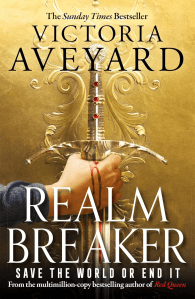
What happens when the heroes fail, and the realm’s last hope falls to a motley crew of warriors, civilians, and criminals? Such is the central conceit of Victoria Aveyard’s Realm Breaker, a high-fantasy novel set in the world of Allward, in which the prologue alone sees the protagonists dealt a crushing defeat. Following this defeat, Domacridhan of Iona, one of the sole survivors, gathers allies, starting with Corayne an-Amarat, the only person alive who can save the realm, in a last-ditch attempt to avert total catastrophe. What follows is a deeply thrilling book, with surprises around every corner, intricate and fascinating world-building, and complex, multi-faceted characters.
Read more: Realm Breaker, by Victoria Aveyard – What happens when the epic quest to save the world fails?Befitting its tagline of “Save the world or end it”, Realm Breaker is a novel which explores the complexities of human nature and our paths in life. This complexity of character is most effectively reflected in Domacridhan and in Sorasa Sarn, an assassin of the infamous Amhara guild. Dom, a member of a race of immortals known as the Vedera, starts as emotionally distant and unfathomable, grieving for Corayne’s father, and for the failed quest, but unable to express this grief; over time, he becomes more open, more expressive, and less distant. Sorasa, likewise, starts as a callous and ruthless assassin, willing to betray Dom for money. Partway through the novel, however, she parts ways with Dom and Corayne, only to find herself reuniting with them immediately after to rescue them from a sudden betrayal by a seeming ally, saving all their lives in the process. A squire named Andry Trelland, a fellow survivor of the failed quest, is likewise complex, divided between his duty to his country, his devotion to his ailing mother, and his desire to save the world. Indeed, this complexity is most powerfully illustrated when he first meets up with Dom, Sorasa, and Corayne; after his queen betrays him and sides with Taristan, he is forced to betray his country in the name of the world and take up arms against fellow squires.
The ally-turned-traitor herself reflects this complexity; she is at once both deeply sympathetic and clearly villainous. She is ruler of a land where many still believe only men should be monarchs, struggling to retain autonomy as a ruler, rather than allowing courtiers or potential suitors to seize her throne. At the same time, she is extremely ambitious, seeking to turn her kingdom into an empire and caring nothing for the lives that will be lost in the process. She is a viewpoint character as well, enabling readers to understand and sympathise with her perspective; indeed, this serves to make her, and by extension Taristan, effective, and thoroughly human, antagonists, as well as giving the reader a perspective separate from the main heroes. However, this complexity does not extend to everyone; for instance, several members of the Companions receive little in the way of characterisation in the first book, with much of this being reserved for the second and third books of the series.
On the other hand, another positive of the book is the extensive world-building and the interweaving narratives. The viewpoint chapters in Realm Breaker are divided between numerous characters, including Dom, Sorasa, and Corayne. Just as the various characters are scattered across Allward, the transitions between the viewpoints takes the reader all across the continent. This allows the reader to experience a great deal of the land and allows the story to feel as if it is moving swiftly. Paradoxically, this use of many different viewpoints also allows for the plot to be slowed down in strategic places, such as the build-up to the traitor’s reveal, which happens across multiple chapters and viewpoints, creating tension and making the reader desperate to learn the reveal. However, the plot is relatively slow to get going, and it drags at places, such as when multiple consecutive chapters are detailing characters travelling. Other reviews have compared this to the occasionally slow style of J. R. R. Tolkien in Lord of the Rings, which makes a considerable amount of sense, as Aveyard has cited Tolkien as an inspiration in her works in the past. It is clear, however, that this implementation of Tolkien’s style has resulted in mixed criticism regarding the plot, with some enjoying it, and others feeling that it is too slow.
Another advantage of the fast-flowing plot is that it powerfully encapsulates another of the story’s themes: that of home, belonging, and wanderlust. Corayne is the most explicit example of this; she begins the novel longing for new horizons, eager to see the world. This wanderlust forms a central part of Corayne’s character, with Corayne both eager to travel, but also feeling a desire to belong in a community. Additionally, this theme is reflected in other characters, including Dom. While Glorian Lost is his ancestral home, he was born and raised in Allward and so considers Allward a home of his own as well. In this, Aveyard very effectively captures the sensation of being caught between two worlds, inheriting varying and occasionally conflicting cultures, and in so doing, she creates protagonists who are relatable to many people around the world.
In turn, this relatability is one of the greatest strengths of Realm Breaker; by creating these complex characters with divided loyalties, Aveyard makes them deeply human and relatable to audiences around the world. Additionally, this makes them interesting to read about and makes it easy to feel invested in the story. Moreover, while some characters are less fleshed out in the first book, it would not be inaccurate to say that they do receive some characterisation through their interactions with the more major characters. The plot, meanwhile, is overall fast-moving and engaging; while there are slower sections in the story, these sections do not adversely affect the novel as a whole. Worldbuilding is done effectively, in a way which – while occasionally frustrating – also inspires the reader to keep reading. All in all, this is an exceptionally good book, with deeply moving characters and themes, and a world which refuses to fade once the story is finished – a testament to Aveyard’s skill as a writer.

 Robert Murrell